
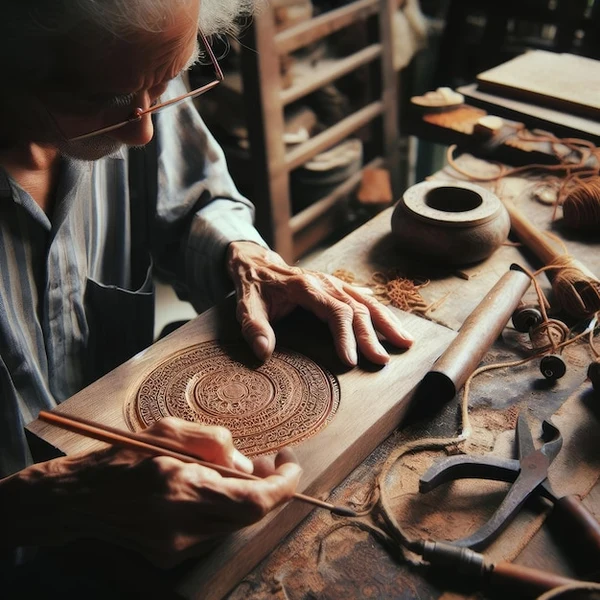
Walk into almost any store, and you can find hundreds of products that look nearly identical. The same shape, the same finish, the same perfectly straight seams, and sometimes even the same little imperfections appear again and again. Mass production has given consumers extraordinary choice at affordable prices, and that is worth celebrating. Most of us would not want to live in a world where every chair, coat, plate, or pair of shoes had to be made individually.
Yet something interesting is happening alongside all that efficiency. People are becoming fascinated with objects that clearly show the presence of another human being.
A hand-thrown ceramic bowl might have a slight variation in its shape. A handmade leather bag may develop a patina that reflects years of use. A piece of jewelry can carry techniques passed between generations. Those differences are not necessarily flaws. They are often the reason someone chooses the object in the first place.
Research suggests that this attraction is more than nostalgia. A 2025 study of 500 consumers found that 25% placed particular value on quality and craftsmanship when comparing handmade and machine-made knitwear, while another 20% were influenced by sustainability and ethical production. Research involving craft consumers has also found that cultural connection and product attributes can significantly influence attitudes toward handicrafts.
Luxury Is Having a Quality Check
Craftsmanship has always been closely associated with luxury, but consumers are becoming more demanding about what the word “luxury” actually means.
A high price and famous logo are no longer enough to settle the question.
The EY Luxury Client Index 2025 found that 62% of luxury clients ranked fabric quality among the top five factors influencing their most recent purchase, while 48% selected brand heritage. Craftsmanship was especially important among older consumers, with 57% of Gen X respondents and 53% of baby boomers identifying it as a major purchase factor.
That creates an interesting challenge for luxury companies. If a product is expensive because of its name rather than the thought, skill, materials, and time behind it, consumers have more reason to question its value.
For Dr. Malini Saba, an entrepreneur, global traveler, and publisher with an interest in luxury, culture, and the stories behind what people create, craftsmanship is interesting precisely because it connects an object with a person.
“I remember visiting a market and stopping at a stall because two pieces that looked similar were not exactly the same,” Saba recalls. “The maker explained where the material came from and why one section had been worked differently. Suddenly, I wasn’t comparing two objects anymore. I was thinking about the person who had spent years learning how to make them. That changed what I thought the item was worth.”
Perfect Is Not Always More Interesting
Modern manufacturing is extremely good at producing consistency.
If you order six glasses, you probably want all six to stand straight. If you buy a replacement part, you certainly want it to fit. Mass production solves real problems, and craftsmanship should not be romanticized to the point where poor quality becomes acceptable simply because something was made by hand.
The more interesting distinction is between consistency and character.
A handcrafted object can contain small variations that tell you how it was made. Those differences create a sense that the item belongs to you rather than to millions of people at once.
Research has found that handmade production can increase perceptions of authenticity, which in turn can influence purchase intention. Other research has linked handmade production with stronger perceptions of cultural value and quality.
That does not mean consumers automatically prefer handmade goods. Price, convenience, maintenance, and availability still matter. The point is that people often see additional value when they understand the human work behind an object.
Craftsmanship Carries Memory
A handmade product can also carry something a factory cannot easily reproduce: cultural memory.
Think about traditional weaving, woodworking, ceramics, tailoring, metalwork, embroidery, or jewelry making. Many of these skills were developed over hundreds of years and adapted to the materials, climate, customs, and needs of particular communities.
When those skills disappear, we lose more than a way of making things. We lose part of the story of how people lived.
This is one reason craftsmanship belongs in conversations about heritage as much as luxury.
Saba remembers encountering artisans whose techniques had been taught within their families.
“What stayed with me wasn’t simply how beautiful the finished piece was,” she says. “It was hearing someone explain that they had learned the technique by sitting beside a parent or grandparent. You realize that buying something like that can help keep knowledge alive. You are not just looking at an object. You are looking at somebody’s history.”
Mass Production and Craftsmanship Do Not Have to Be Enemies
It would be easy to turn this into an argument that handmade is good and mass production is bad, but that would ignore reality.
Mass production makes essential goods affordable. It allows companies to maintain safety standards, provide consistency, and serve enormous populations. Few people want their refrigerator or car assembled according to the maker’s creative mood that morning.
Craftsmanship serves a different purpose.
It becomes particularly valuable when individuality, heritage, durability, artistry, and emotional connection matter.
The smartest brands may therefore be the ones that understand when efficiency matters and when the human touch deserves protection.
Luxury companies already face pressure to demonstrate that higher prices correspond with genuine value. Vogue reported in 2025 that the luxury industry lost roughly 50 million customers during 2024, citing Bain data, while its survey of almost 1,000 readers found growing concerns about whether luxury still delivers sufficient quality for its price.
That makes craftsmanship more than a romantic marketing story. It can become evidence that there is something behind the price tag.
How Consumers Can Support Real Craftsmanship
Supporting craftsmanship does not require replacing everything in the house with handmade objects. A more realistic approach is to become selective.
Before buying something intended to last, ask who made it and where it came from. Look for companies that explain their materials and production methods instead of relying entirely on vague language about heritage.
When their budget allows, consumers can also buy fewer items and choose better ones. A well-made object that lasts for years may offer more value than repeatedly replacing cheaper alternatives.
Visiting local markets, workshops, independent stores, and artisan fairs is another simple way to discover makers. When traveling, purchasing directly from craftspeople can also create a more meaningful connection with a destination than buying another generic souvenir.
Most importantly, ask questions. A genuine craftsperson can usually tell you far more about an object than its price tag ever will.
Brands Need to Show the Hands Behind the Product
Companies that rely on craftsmanship should also stop hiding the people doing the work.
Consumers should be able to learn who makes a product, what techniques are involved, how long those skills take to master, and why particular materials were chosen.
Morning Consult research involving 2,203 U.S. adults found that consumers tend to associate luxury strongly with quality and service, while high cost alone is not necessarily what makes an experience feel luxurious.
That distinction matters.
If craftsmanship is genuinely part of a brand’s value, companies should demonstrate it rather than simply placing the word “artisan” on a label.
Human Skill Still Has a Place
The world is not going to abandon mass production, nor should it. Efficiency has improved everyday life in countless ways.
However, efficiency does not satisfy every human desire.
People still want objects with stories. They still appreciate knowing that someone spent years becoming exceptionally good at something. They still value traditions that connect the present with generations that came before.
As Saba puts it, “When I meet someone who can explain every stage of making an object because they have done it with their own hands for twenty or thirty years, I pay attention. That kind of knowledge cannot be rushed. If we stop valuing it, we may discover too late that some skills are much harder to bring back than they were to lose.”
Perhaps that is why craftsmanship continues to matter. In a world capable of making millions of identical things, there is still something wonderfully compelling about an object that reminds us a person was there.


